
AI Resources for the C-Suite
Free resources for business leaders—a taste of what we teach. Prompts, videos, and practical AI techniques you can use today.
Trusted by 600+ companies and 4,000+ executives we've helped train.


















A Preview of What We Teach
Our Foundations Bootcamp teaches techniques you can use immediately. Here's a taste.
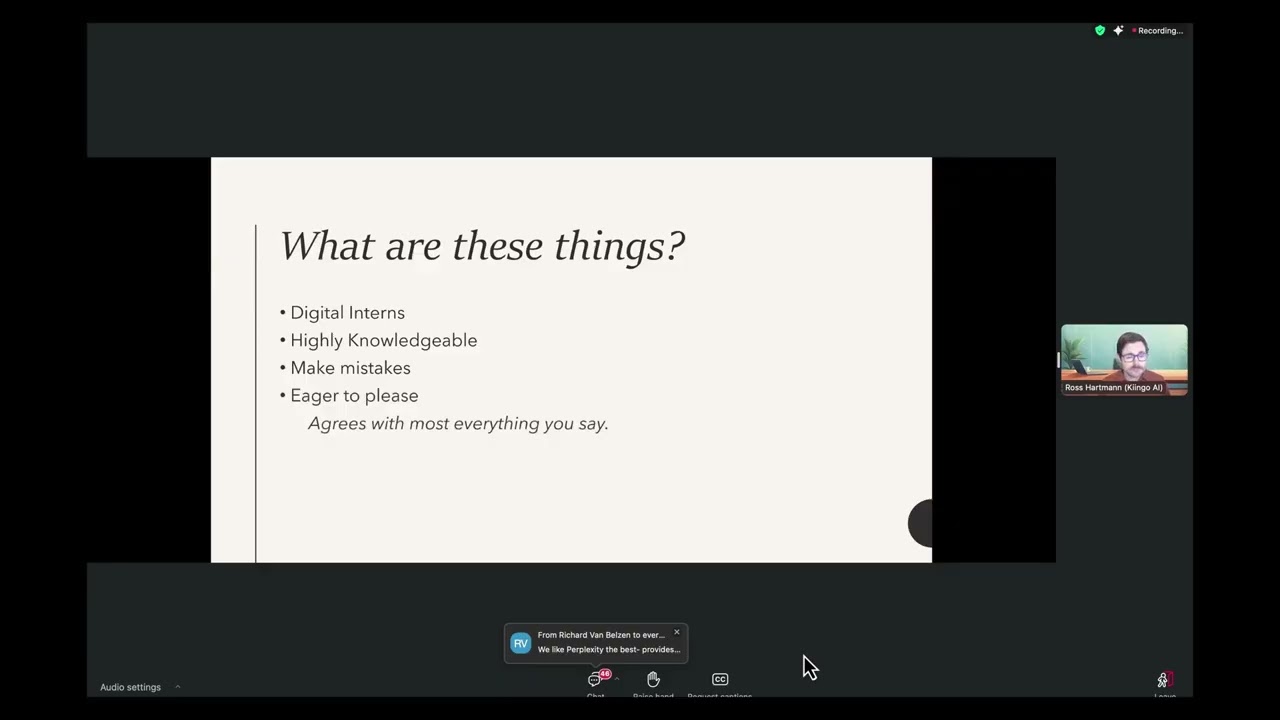
Think of AI Like Your Digital Intern
Intro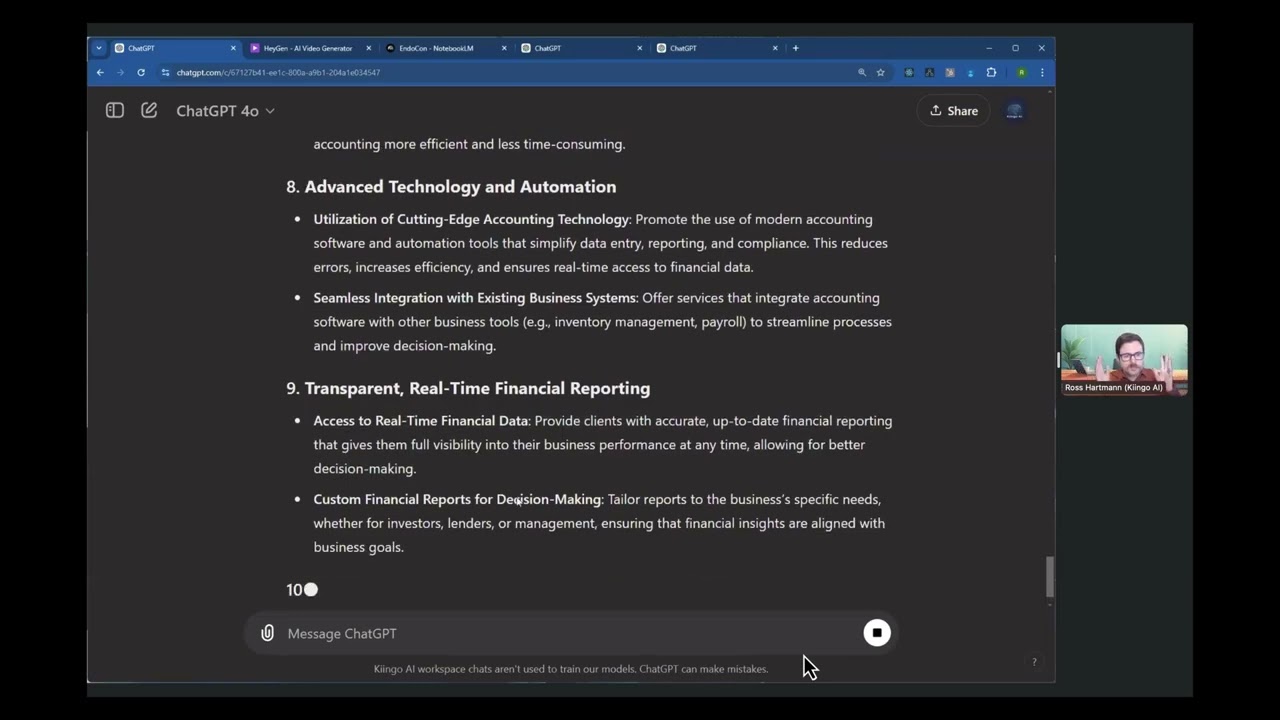
Priming: The Key to Better AI Responses
Technique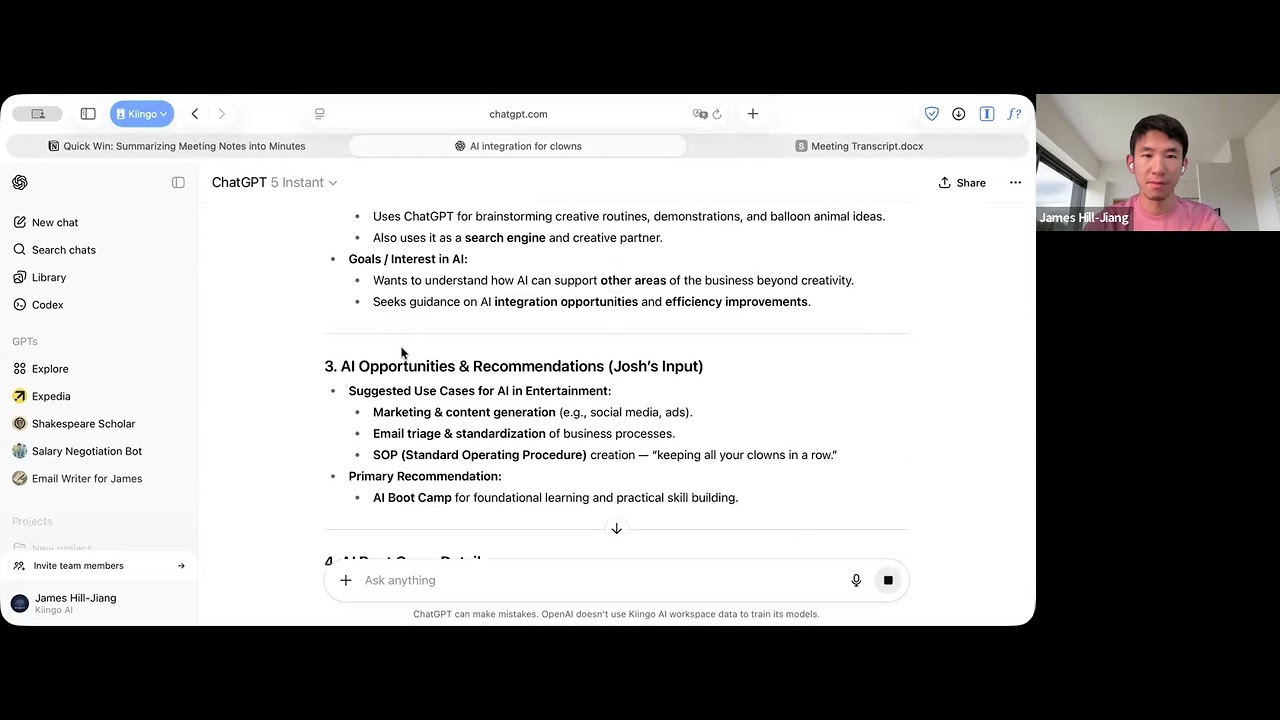
Quick Win: Summarizing Meeting Notes
Quick WinWant the full curriculum?
These clips are just a preview. See why Vistage Chairs keep coming back to our AI Peer Groups.
"Ross knows his stuff—it's not something he bolted on. He knows the backstory as well as where things are heading. I created an agent to serve as a Chair collaborator with me. It made it faster to prepare for meetings and gave me ideas for what to do to add members."— Ellen Moore, CEO/Founder, Moore Creative Strategies Vistage Chair
Why AI Matters for Executives
AI isn't just for productivity—it's a strategic thinking tool.
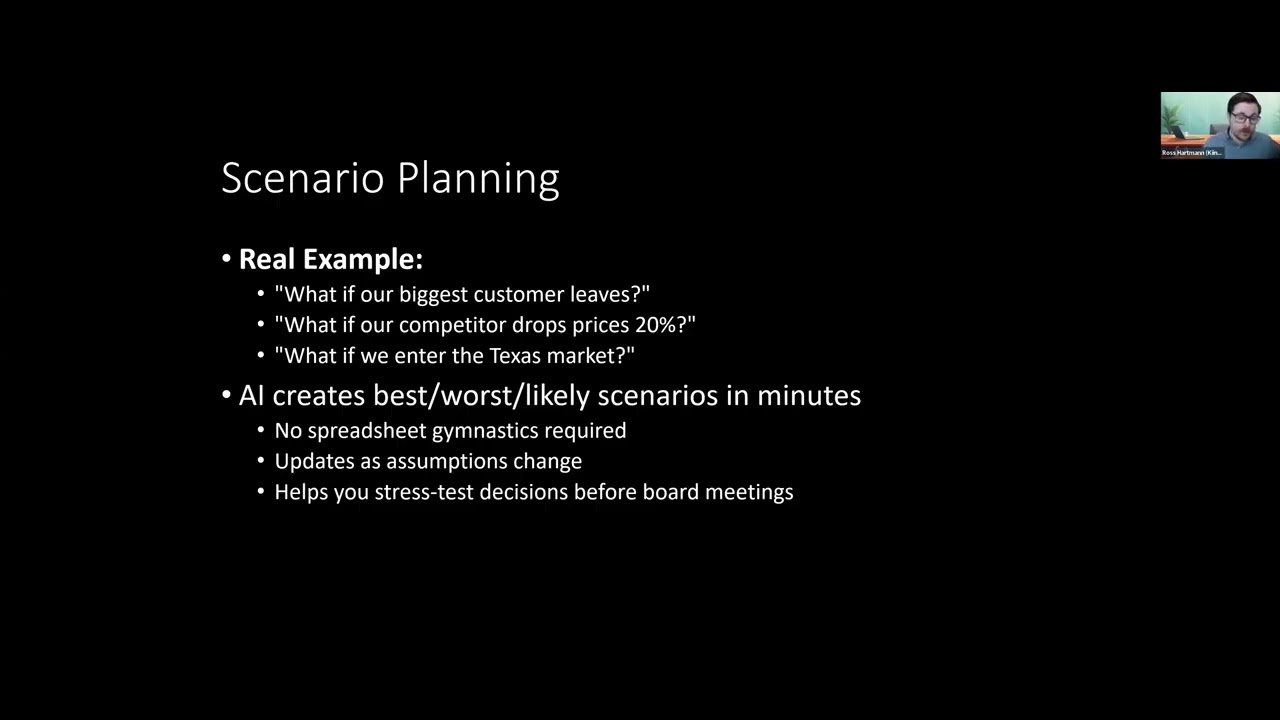
Why AI Matters for Executives
Overview
ChatGPT as Your Board of Advisors
Strategy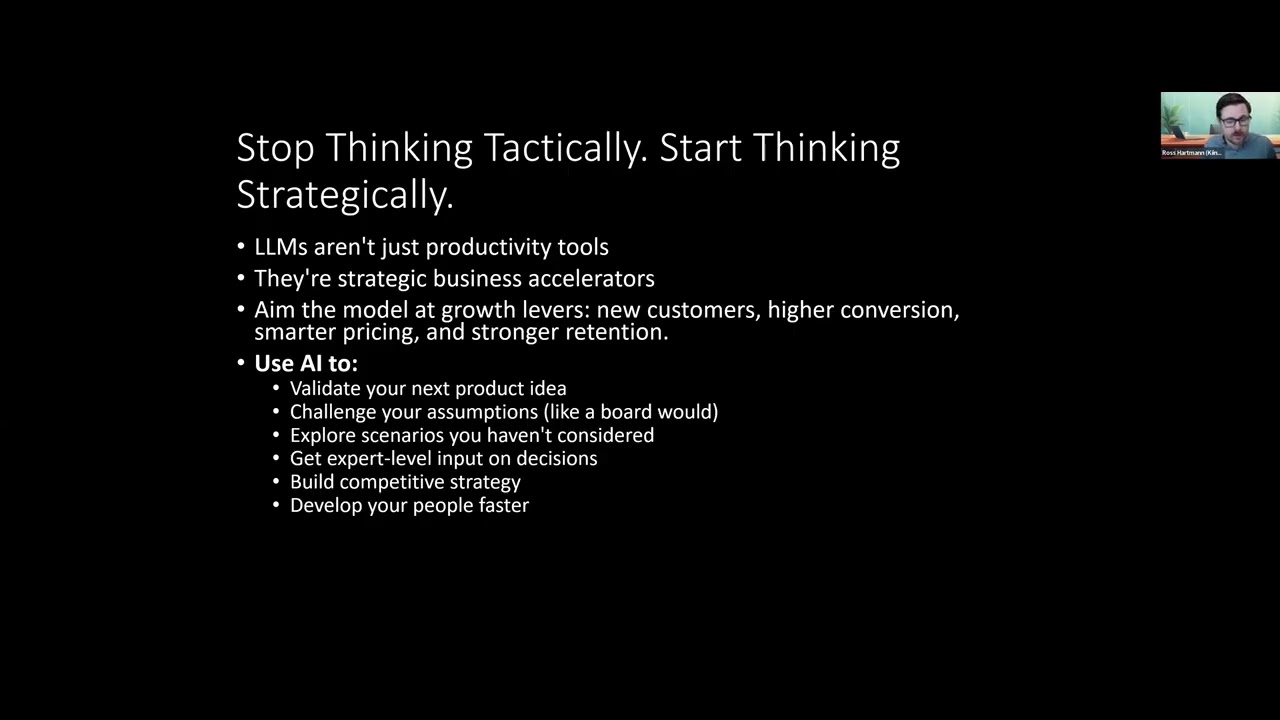
War Gaming with AI
DecisionsWhat would you do with 5-15 hours back every week?
This is the part most "AI initiatives" skip: turning time savings into actual output. In the Champions community, executives build tools that amplify what their teams do best and eliminate manual, repetitive tasks. They drive learning about new capabilities and accelerate adoption across the organization.
Real Examples From the Kiingo Orbit
- Robert Moore built a fleet of specialized GPTs—one for ERP naming, one for talent pipeline review, one for prompt generation itself. He reported going from 10% to 75% adoption.
- Ellen Moore created an AI collaborator that helps prepare for Chair meetings faster and generates ideas for growing her Vistage membership.
- Bill Kern started building management best-practice apps using AI-based coding. He reported going from 10% to 90% adoption.
These leaders built real AI capability through our peer groups, six-week bootcamp, and AI for Automation bootcamp. What would you build?
Let's Talk About How to Get Real ROI from AIHow to Use These Prompts
- Copy the prompt exactly as written into ChatGPT, Claude, or Gemini
- Replace the [BRACKETED TEXT] with your specific information
- Review and refine – these are starting points, not final drafts
Start with Prompt #1. It teaches AI who you are, making every other prompt 10x more relevant.
Your Executive Context Prompt
15 min to set up, saves hours foreverThis is the foundation. Create it once, paste it at the start of any AI conversation, and watch responses transform from generic to genuinely useful. It's like briefing a new executive assistant—except you only do it once.
# My Context

## About Me
- Name: [Your Name]
- Role: [CEO/CFO/COO/CMO/etc.] at [Company Name]
- Years in role: [X years]
- Background: [Brief career background relevant to current role]

## About My Company
- Industry: [e.g., Commercial Construction, Manufacturing, Professional Services]
- Employees: [Number]
- Annual Revenue: [Range, e.g., $15-50M]
- Company Age: [Years in business]
- Ownership: [Private, Family-owned, PE-backed, Public, etc.]
- Geography: [Primary markets/locations]

## My Key Priorities This Quarter
1. [Priority 1 - e.g., "Improve operational efficiency by 15%"]
2. [Priority 2 - e.g., "Develop succession plan for key roles"]
3. [Priority 3 - e.g., "Evaluate AI adoption for back-office functions"]

## My Communication Style Preferences
- I prefer: [Direct and concise / Detailed analysis / Executive summaries first]
- Typical decisions I make: [Strategic partnerships, capital allocation, hiring leadership, etc.]
- I report to: [Board, Investors, Family ownership group, CEO, etc.]

## Important Context
- [Any other relevant info: Vistage/EO/YPO member, recent acquisition, growth phase, industry challenges, etc.]

---
When responding to me, remember this context. Be direct, avoid jargon, and give me actionable recommendations—not just information. I can handle hard truths.
AI without context is like hiring someone who knows nothing about your business. Use this before jumping into ChatGPT with a question—it front-loads the 20% of information that drives 80% of relevance.
Learn to Use AI Effectively—With Other Business Leaders
This context prompt is just the first step. Join our AI Peer Groups to master AI alongside executives facing the same challenges—learn together, share wins, and build real capability.
Your Skeptical Advisor & Thinking Partner
Use anytime you need to pressure-test an ideaThe best advisors aren't yes-men. This turns AI into a skeptical-but-constructive board member who challenges your assumptions, finds the holes in your logic, and helps you think through problems more rigorously. Like having a trusted peer available at 11pm.
I want you to act as a skeptical but constructive advisor—like a seasoned board member or peer group member who genuinely wants me to succeed but won't let me get away with fuzzy thinking.

Your job is NOT to:
- Tell me what I want to hear
- Just validate my ideas
- Be negative or dismissive

Your job IS to:
- Challenge my assumptions respectfully
- Find the holes in my logic
- Ask the hard questions I might be avoiding
- Play devil's advocate when useful
- Help me see blind spots
- Push back when something doesn't add up
- Ultimately help me make better decisions

COMMUNICATION STYLE:
- Be direct and concise
- When you disagree, explain why
- Ask probing questions rather than just stating opinions
- If I'm overcomplicating something, say so
- If I'm missing something obvious, point it out
- Give me your honest assessment, even if it's uncomfortable

---

HERE'S WHAT I'M THINKING THROUGH:

[Describe your situation, idea, decision, or problem. Be specific. Include:
- What you're considering doing
- Why you think it might work
- What's at stake
- Any concerns you already have
- Context that matters]

---

Please:
1. Start by making sure you understand what I'm actually trying to accomplish
2. Identify the 2-3 assumptions I'm making that could be wrong
3. Ask me the questions I should be asking myself
4. Tell me what you'd want to know if you were in my shoes
5. Give me your honest reaction—including if you think I'm on the right track

Don't hold back. I'd rather hear hard truths now than learn them the expensive way later.
Use for: major hiring decisions, strategic pivots, partnership opportunities, capital allocation, pricing changes, org structure decisions—any time you'd normally want to talk it through with a peer. Follow up with "What am I still not seeing?" and "If this fails, what's the most likely reason?"
Want 50+ prompts like this?
The Resource Vault has prompts for executives, finance, operations, HR, and more—updated monthly as AI evolves.
Spreadsheet Analysis & Data Help
2 min vs. 30 min Googling formulasEvery executive lives in spreadsheets. Stop wrestling with Excel formulas or trying to make sense of raw data. Describe what you need in plain English, get the exact formula or analysis back. Works for budgets, forecasts, dashboards, and ad-hoc analysis.
I'm working in Excel/Google Sheets and need help with [CHOOSE ONE]:

OPTION A - BUILD A FORMULA:
My data structure:
- Column A: [What's in it, e.g., "Date"]
- Column B: [What's in it, e.g., "Product Name"]
- Column C: [What's in it, e.g., "Sales Amount"]
- [Add more columns as needed]

What I need to calculate: [Describe in plain English, e.g., "Sum all sales for Product A in January 2024" or "Find the average order value by customer" or "Flag any row where the amount exceeds $10,000"]

---

OPTION B - FIX A BROKEN FORMULA:
Here's my formula that isn't working:
[PASTE YOUR FORMULA]

What it's supposed to do: [Explain expected behavior]
What it's actually doing: [Explain the problem—error message, wrong result, etc.]

---

OPTION C - ANALYZE THIS DATA:
[PASTE YOUR DATA - up to ~100 rows works well]

Please analyze this data and tell me:
1. What are the key trends or patterns?
2. What stands out as unusual or worth investigating?
3. What would you recommend I look at more closely?

---

Please explain your formula/analysis so I understand the logic.
For complex spreadsheets, paste a sample of your data (headers + 10-20 rows). AI can build formulas that work on your actual structure, not generic examples. CFOs: use Option C for quick variance analysis on monthly reports.
Want to learn with other executives?
Join the AI Champions Peer Group—monthly peer sessions where leaders share what's working (and what isn't) with AI.
30-60-90 Day Onboarding Plan
15 min vs. starting from scratchEvery new hire deserves a clear path to success. Generate role-specific onboarding plans that set expectations, define milestones, and reduce time-to-productivity. Especially critical for leadership hires where early wins matter.
Create a 30-60-90 day onboarding plan for a new hire.

ROLE DETAILS:
- Position: [Job Title]
- Department: [Department]
- Reports to: [Manager Title]
- Direct reports: [Number, if any]
- Start date: [Date]

COMPANY CONTEXT:
- Company: [Name and brief description]
- Industry: [Industry]
- Company size: [Employees]
- Current priorities: [What's the company focused on right now?]

ROLE EXPECTATIONS:
- Why we hired this person: [What problem are they solving?]
- Key responsibilities: [List 3-5 main responsibilities]
- Success metrics: [How will we measure their performance?]
- Biggest challenges: [What will be hardest about this role?]

Please create a 30-60-90 day plan with:

FIRST 30 DAYS - "Learn & Listen"
- Key people to meet and why
- Systems and processes to learn
- Quick wins to target
- Success criteria: "By day 30, they should be able to..."

DAYS 31-60 - "Contribute & Build"
- First projects to own
- Relationships to deepen
- Success criteria: "By day 60, they should have..."

DAYS 61-90 - "Lead & Optimize"
- Full ownership expectations
- Strategic contributions expected
- Success criteria: "By day 90, they should be..."

Format this as a document I can share with both the new hire and their manager.
Create a template for each key role type (Sales, Operations, Finance, etc.) and save them. When you hire, customize with role-specific details rather than starting from scratch every time.
Get weekly AI tips in your inbox
Subscribe to our newsletter for practical AI insights, new prompts, and executive use cases—no fluff, just what works.
Frequently Asked Questions
Have more questions? Visit our full FAQ page →
Not at all. Our programs are designed for business leaders, not engineers. If you can use a web browser, you can master AI. We focus on practical application—real workflows that save time—not technical theory.
Yes—these prompts work in ChatGPT, Claude, Gemini, and most major AI tools. Just paste them in, replace the bracketed text with your information, and you're ready to go. No special setup required.
For most business tasks, they're interchangeable. Start with whichever you have access to. In our bootcamp, we cover the strengths of each tool and when to use what—but you don't need to pick the "right" one to get started.
Most prompts actually work better as a conversation—multiple back-and-forth messages where you refine, push back, and dig deeper. These templates give you a strong starting point, but the real value comes from following up when the first answer isn't quite right.
Our bootcamp participants typically save 5-15 hours per week once they implement the workflows we teach. Some see results from day one; most hit their stride within the first few weeks.
We help companies adopt AI through hands-on training, strategy sessions, and ongoing resources. Our Foundational AI Bootcamp is a six-week program that builds AI fluency across your team. The Resource Vault gives you 50+ prompts and use cases, updated monthly. And our AI Champions Peer Group provides ongoing peer support and accountability.
Explore Our Solutions
These prompts are just a starting point. Here's how we help teams go further. See all solutions →
What Leaders Are Saying
"Fifteen of our team members recently attended the Kiingo AI Bootcamp, and it exceeded expectations. The training was engaging, relevant, and directly applicable to our work."
"Hopelink is sending our second round of senior leaders through the Kiingo AI Bootcamp. Ross and his team have been responsive and supportive in preparing us for safe, responsible implementation."
"Kiingo's AI Bootcamp was amazing. It completely transformed how I use ChatGPT and turned it into a life-changing tool—like unlocking a new level of productivity."
"The foundation Kiingo provided gave us a strong foundation on how to use AI. Now we are applying it in more parts of our business—and I would say yes, Kiingo is worth it."
"I recently attended the AI Bootcamp, and it was an outstanding experience. The instructors were knowledgeable, approachable, and genuinely invested in our success."
"Kiingo did a great job explaining complex concepts and showed a deep understanding of the strengths and limitations of the LLMs. Their ability to break things down left me with actionable insight."